


Haven’t we talked enough about AI and its future in business? Perhaps. So this is not another discussion about what AI might do someday, or another list of predictions about how it will change our lives. It is about something more tangible. Something technical. Something we can actually build.
For me, three things came together in the past months: the launch of the SAP Business AI Platform, the content shared during SAP Devtoberfest 2026, and, most recently, the SAP CodeJam “Build Code-Based AI Agents on SAP Business Technology Platform,” hosted by SAP Developer Advocate Nora Von Thenen.
In this post, I share what I took away from that journey: why building an AI agent is the easy part, which SAP building blocks turn a language model into something useful for the business, and what this means for those of us who design and develop SAP solutions.
Why building the agent is the easy part
Agentic AI is everywhere in the conversation right now. But what does it actually look like when you start building an AI agent in the SAP ecosystem?
Having access to powerful AI models is one thing. Turning them into something useful in a real business environment is an entirely different challenge. An agent that answers questions convincingly in a demo still has to understand business data, interact with existing systems, and work reliably in a productive environment. That is where most of the effort goes.
For companies running SAP in manufacturing, supply chain, or logistics, this gap matters. An agent only creates value if it works with the right data, respects existing processes and architecture, and can be operated and governed like any other part of the system landscape. Getting there requires experimentation, technical knowledge, and a clear understanding of where AI can create real value.
Learning by Building: SAP Devtoberfest and the SAP CodeJam
For anyone who hasn’t come across SAP Devtoberfest yet, think of it as a month-long celebration of the SAP developer community: a whole month packed with learning, experimenting, and sharing knowledge.
From integration and data governance to building apps and exploring new technologies, there is something for everyone. With daily sessions, hands-on exercises, and plenty of community-driven content, Devtoberfest gave me the perfect opportunity to step outside my usual routine and try something new at my own pace.
This year, AI was hard to miss. It took center stage in the sessions I followed, sparking ideas and giving me plenty to explore beyond the usual development topics.
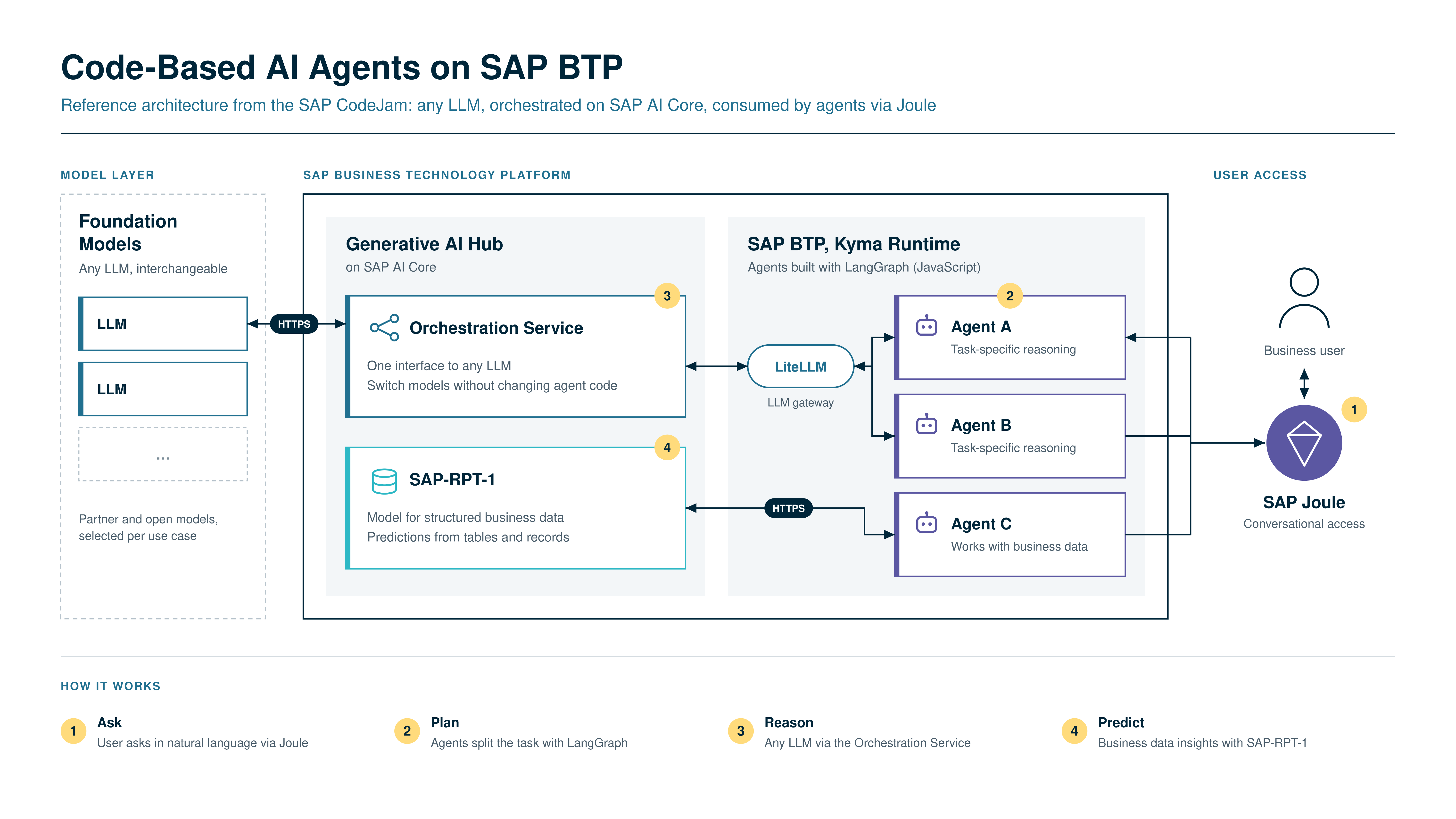
The SAP CodeJam then took this one step further. We explored how to build code-based AI agents using Generative AI Hub on SAP AI Core, SAP-RPT-1, Grounding Service, and SAP AI Launchpad, with deployment on SAP Business Technology Platform (SAP BTP) and integration into SAP Joule.
Some of these technologies were already familiar to me, so I joined with a different goal: to go beyond individual components and get a closer look at how SAP approaches the development of code-based AI agents. It was a chance to exchange ideas, discuss best practices, and better understand how the different building blocks fit together.
The Building Blocks Behind a Code-Based AI Agent
Each of the components we worked with solves a specific part of the problem:
- Generative AI Hub on SAP AI Core: Instead of reinventing the wheel for every AI use case, Generative AI Hub gives developers access to different language models through a common interface. This makes it easier to experiment and find the right model for the job
- SAP-RPT-1: Business data isn’t always a nice, clean conversation waiting to happen. SAP-RPT-1 is designed to understand structured business data, helping us get more value out of the tables and records that drive everyday business processes. The demos at rpt.cloud.sap are well worth a look.
- Grounding Service: AI is great at generating answers, but how do we make sure those answers are based on the right information? Grounding Service connects an agent’s responses to relevant source material, making them more reliable in a business context.
- SAP AI Launchpad: Building an AI solution is one thing; keeping track of what is running behind the scenes is another. SAP AI Launchpad provides a central place to manage and monitor AI resources and deployments.
- SAP Joule: What good is an AI agent if nobody can easily interact with it? SAP Joule brings AI into the SAP user experience and offers a conversational way to access capabilities and get things done.
Put together, these components mark a clear shift. We move from simply asking an AI model a question to building an agent that understands a task, works with business context, uses the right capabilities, and becomes part of an actual business process.
What the SAP Business AI Platform Changes for Developers
As a developer, I’m used to thinking about applications, APIs, integrations, and how to keep everything aligned with Clean Core. With AI agents entering the picture, I’m starting to ask myself a different set of questions. That is what makes the SAP Business AI Platform interesting to me.
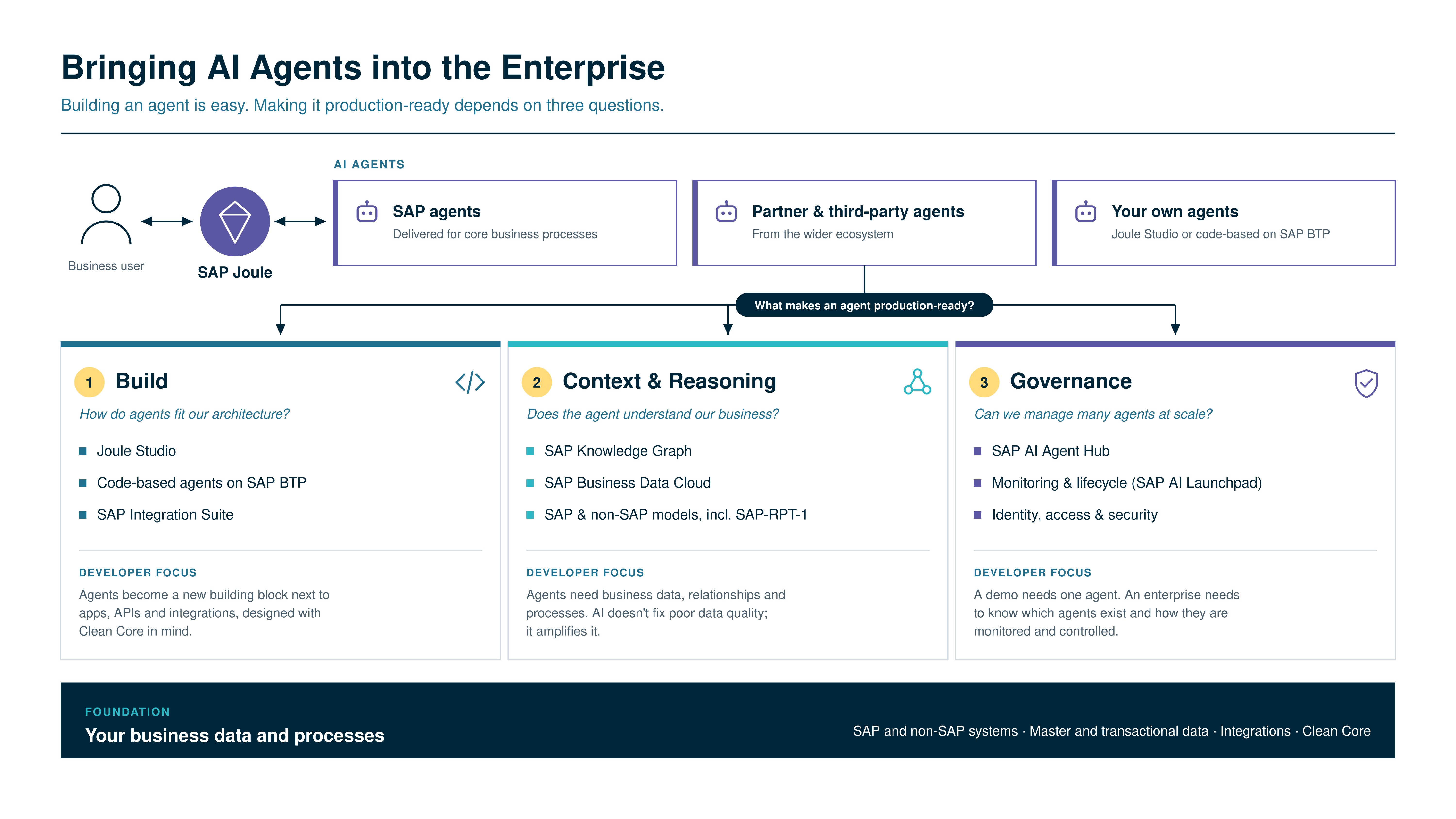
I see it as an evolution of the SAP BTP development landscape. Not because we suddenly need to forget everything we know about building applications, but because we are adding a new kind of building block to the picture: AI agents. And that changes three things.
1. How we build
I’m already building extensions and applications with Clean Core in mind. Now I can start thinking about where AI agents fit into that architecture, whether I generate them through Joule Studio or develop them myself. For me, this isn’t about replacing traditional development. It’s about figuring out where agents actually make sense and how they fit into the solutions we are already building.
2. Context and data quality
We have all seen what happens when an AI model has no idea what it is actually talking about. In an enterprise, knowing the language isn’t enough. An agent needs to understand business data, relationships, and processes. That is where knowledge graphs and SAP Business Data Cloud become relevant.
But there is a catch: AI won’t magically fix poor data quality. If our data is a mess, we bring that mess straight into our AI solutions. Clean, well-structured master and transactional data remains the foundation, with or without agents.
3. Governing more than one agent
What happens when we have more than one agent? This is the question I think we need to take seriously as developers. Creating an agent and getting it to work in a demo is one thing. Knowing which agents exist, how they are managed, and how we monitor and govern them across an organization is another. The SAP AI Agent Hub is part of SAP’s answer to this challenge, providing a central place to get visibility into the agent landscape.
Looking at these three aspects together, I keep coming back to one thought: we are not just adding AI to our development toolbox. We are also taking on new architectural and operational responsibilities.
Conclusion: From What We Can Build to What Actually Works
Honestly, that is what makes this space so interesting to me. Choosing a model is only one small part of the equation. We still need to think about architecture, data quality, integration, security, and governance. All the things we already care about as developers, just in a world where some of our building blocks can now reason and act.
Hands-on formats like SAP CodeJams and Devtoberfest are an important part of that learning journey. For me, exploring them is about more than keeping up with new technology. It is about building the knowledge needed to understand what is possible today, identify the opportunities that matter tomorrow, and make informed decisions about where AI can support the business.
The key takeaways:
- Building an agent is quick; making it reliable, grounded, and integrated is where the real work lies.
- SAP’s building blocks, from Generative AI Hub and Grounding Service to SAP AI Launchpad and Joule, cover the path from model to business process.
- Clean Core principles, good data quality, and agent governance matter just as much as model choice.
The question is no longer just what we can build with AI, but how we build something with it that actually works in the enterprise. If you are asking yourself the same question, I’d be glad to exchange experiences.